For the past five years, the Infrastructure Investment and Jobs Act (IIJA) has helped fund highway preservation, bridge improvements, fish passage projects, freight corridors, safety improvements and local transportation investments in Washington State
Now, with the IIJA set to expire on September 30, 2026, Congress is considering its successor: the BUILD America 250 Act, a bipartisan five-year transportation authorization that would invest approximately $580 billion in highways, bridges, freight, transit, passenger rail and transportation safety through 2031.
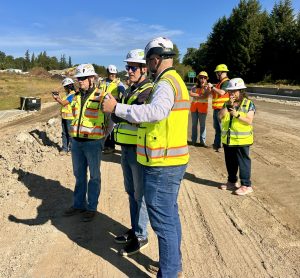
Last week, AGC staff and members met with Congressman Rick Larsen and Congresswoman Marilyn Strickland and discussed BUILD America 250, among other topics. Rep. Larsen toured two jobsites in Whatcom County, one hosted by Granite and one by IMCO (see pics). “You can’t have a big-league economy with little-league infrastructure,” Larsen said about the legislation. “The BUILD America 250 Act makes key investments in the nation’s transportation—from restoring aging bridges and repairing crumbling roads to building out safe, accessible transit and bike infrastructure.”
Rep. Strickland met with AGC in Tacoma and expressed her support for BUILD America 250 as well as military construction funding for JBLM. Both Larsen and Strickland are members of the US House Committee on Transportation and Infrastructure.
AGC told both policymakers that Washington State cannot afford to lose the certainty that comes with a long-term transportation bill.
The BUILD America 250 Act would:
- Continue the core federal highway formula programs that fund most WSDOT highway investments.
- Provide the largest federal bridge investment ever included in a surface transportation authorization.
- Continue significant investments in freight mobility and nationally significant highway projects.
- Support passenger rail, transit and highway safety improvements.
- Expand efforts to streamline project delivery and reduce unnecessary permitting delays.
- Improve the long-term solvency of the Highway Trust Fund through new user-fee revenues, including fees on electric vehicles and plug-in hybrids.
For the industry, the value of BUILD America 250 is not simply the funding level—it’s the certainty that comes with a five-year authorization.
Transportation construction depends on long-term planning. WSDOT develops projects years before they are advertised, contractors make multi-year investments in equipment and personnel, and apprenticeship programs require stable workloads to recruit and train the next generation of workers.
A predictable federal program allows WSDOT and local governments to confidently advance projects, enables contractors to invest in workforce and equipment, helps suppliers manage production and pricing, and ultimately reduces costs associated with stop-and-start funding cycles.
What It Means for Washington
For Washington, BUILD America 250 is much more than a national transportation bill—it is the framework that will determine the size and stability of WSDOT’s federal construction program for the next five years.
The legislation would authorize approximately $580 billion nationwide between FY 2027 and FY 2031, including roughly $475 billion in Highway Trust Fund contract authority and approximately $105 billion that would be subject to future appropriations. The vast majority of highway funding would continue to flow to states through established formula programs, providing the predictability transportation agencies rely upon for long-term planning.
Although the legislation does not allocate funding state-by-state, Washington has historically received approximately 2 percent of all federal highway formula funding. If the final legislation is enacted substantially as proposed, Washington could expect to receive approximately $7.5 to $8.5 billion in federal highway formula funding over the next five years—or roughly $1.5 to $1.7 billion annually—before accounting for additional competitive grant opportunities.
Those federal dollars help fund:
- Highway preservation
- Bridge replacement and rehabilitation
- Interstate modernization
- Freight mobility improvements
- Fish passage projects
- Highway safety improvements
- Hundreds of local transportation projects across Washington
The legislation also contains provisions that are particularly important for Washington, including historic bridge investments, continued support for nationally significant freight corridors, and enhanced ferry funding opportunities that recognize the importance of Washington’s ferry system and maritime economy.
For Washington’s construction industry, BUILD America 250 has the potential to sustain a federal transportation program exceeding $1.5 billion annually while providing the funding certainty WSDOT and local agencies need to keep projects moving, avoid costly delays and maintain a strong construction workforce.
The Road Ahead
The House Transportation & Infrastructure Committee has completed its work, but Congress still has important steps ahead. The House has not yet voted on the bill, the Senate is developing its own transportation reauthorization proposal, and the two chambers will ultimately need to reconcile their differences before sending a final bill to the President.
In the meantime, Congress is considering a short-term continuing resolution to prevent an interruption in federal transportation funding. While a continuing resolution is preferable to a lapse in funding, it should serve only as a bridge to enactment of a full five-year authorization—not as a substitute for one.
Continuing resolutions create uncertainty for transportation owners, contractors and suppliers. They can delay project decisions, postpone discretionary grant awards, complicate workforce planning and make it more difficult for contractors to invest in equipment, apprenticeships and long-term capacity.
AGC thanks Reps. Larsen and Strickland for their active support of the bill. AGC of America PAC has financial contributions to each of their respective reelection efforts.
Photo caption 1: Jerry VanderWood, Michele Willms, Mike Hall (Tucci and Sons) and David D’Hondt meet with Congresswoman Marilyn Strickland (center). Rep. Strickland serves on both the US House Committee on Transportation and Infrastructure, and Armed Services.
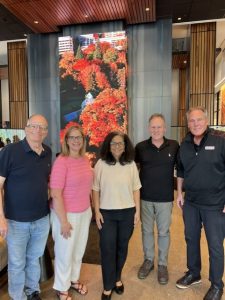
Photo caption 2: Rep. Rick Larsen (far right) chats with IMCO staff during a tour of IMCO’s R.G. Haley and Cornwall Avenue Landfill Site Cleanup project along the Bellingham Bay waterfront.
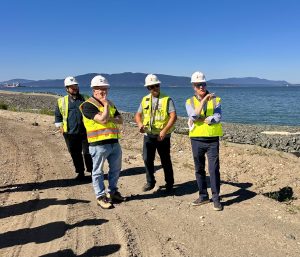
Photo caption 3: Rep. Larsen with the Granite crew during a tour of Granite’s Secret Creek Fish Passage project